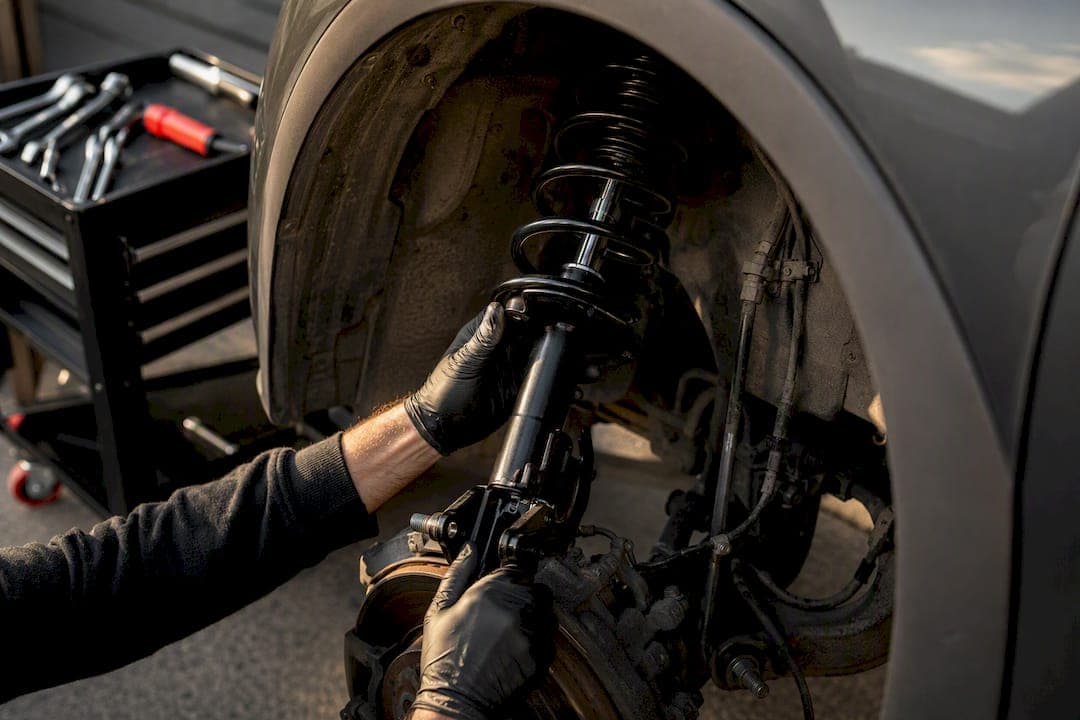
Replacing a pair of shock absorbers on a mainstream family car typically costs between £150 and £400 in the UK, parts and labour included. Prices climb well past £600 for premium marques, and adaptive or air suspension systems can push a single corner beyond £1,000. The final figure depends heavily on your vehicle type, whether you're fitting shocks or full struts, parts quality, and how much corrosion the mechanic finds once the wheel comes off. Get an itemised quote before you agree to anything.
TL;DR:
- Replacing shocks on a regular family car typically costs between £150 and £250 for a pair of economy parts, with premium options exceeding £550.
- Costs increase significantly for vehicles with adaptive or air suspension, with repairs sometimes reaching into the thousands due to additional calibration and compressor parts.
- Mismatched shock replacement or neglecting corrosion can lead to higher labour costs, extra parts, or need for full alignment, especially on strut assemblies.
- Signs of failing shocks include excessive bounce, nose-diving under braking, body roll, and visible leaks, which might cause a car to fail MOT tests.
- Mobile mechanics are suitable for straightforward shock swaps without alignment or electronics, providing clear estimates and convenience at the driver’s home or workplace.
Table of Contents
- How much does shock absorber replacement cost in the UK?
- What actually changes the price you're quoted?
- What are the warning signs your shocks are failing, and will they fail your MOT?
- What happens when a garage replaces your shock absorbers?
- How long do shock absorbers last, and how do you stretch that lifespan?
- How do you get an accurate quote for shock absorber replacement?
- When does a mobile mechanic make sense for a shocks job?
- Book a mobile mechanic for your shock absorber replacement
- Where these figures come from
- Sources
How much does shock absorber replacement cost in the UK?
The honest answer is: it depends on what's underneath your car, but there are solid benchmarks worth knowing before you ring around for quotes.
For a typical hatchback, saloon or small SUV, replacing a pair of shocks (both front or both rear) generally runs a few hundred pounds, according to RAC's cost guide, which tracks UK averages across common models. ClickMechanic's job pricing puts a similar spread on the table, with variation driven mainly by garage type and parts brand rather than the job itself changing much between cars.
At the budget end, you're looking at economy aftermarket shocks fitted by an independent garage or mobile mechanic, with straightforward labour and no surprises underneath. At the premium end, you're paying for OE-equivalent or manufacturer-branded parts, dealer labour rates, and often a bit of extra time dealing with mounts or bushings that need attention alongside the shocks themselves.
Front pair vs rear pair. Front shocks tend to sit slightly higher in price because they often integrate with steering components and are more exposed to load and cornering forces. Autodoc's UK pricing breakdown suggests rear pairs can come in a little cheaper on many models, purely because access is simpler and there's less to disturb.
Here's a rough breakdown by scenario:
- Front pair, economy parts, independent garage: roughly £150 to £250
- Front pair, premium/OE parts, dealer or specialist: £350 to £550+
- Rear pair, economy parts: £130 to £220
- Rear pair, premium parts: £300 to £480
- Full set (all four corners): £350 to £750 on a mainstream car, more on larger vehicles
Pro Tip: Never replace shocks in isolation on one side only. Mismatched damping side-to-side changes how the car handles under braking and cornering, and most garages will refuse to fit a single new shock next to a worn one for exactly this reason.
A full four-corner replacement isn't always necessary, but it's common when a car has covered high mileage and one axle is already showing wear. Replacing all four at once often saves on labour compared with doing it in two separate visits, and CurrentCost's example job breakdowns show total costs for a full set landing meaningfully below the sum of two separate axle jobs once you account for shared setup time.
Where costs genuinely escalate is adaptive damping and air suspension. These systems use electronically controlled valves, height sensors, and sometimes onboard compressors, all of which cost considerably more to replace and often need calibration afterwards. Blog analysis from Empire Auto Protect documents air suspension corners running into four figures once you include compressor or module issues, a world away from a standard coil-over shock. If your car has adjustable ride height or a "comfort/sport" suspension setting, budget accordingly and ask specifically whether the quote covers parts, calibration, and diagnostic time.
It's also worth flagging that price guides from outside the UK, such as RepairPal's US estimator, show noticeably different figures. Labour rates and parts distribution work differently there, so treat those numbers as context rather than a UK price point.
What actually changes the price you're quoted?
Two garages can quote wildly different prices for what looks like the same job, and it's rarely one of them ripping you off. Here's what genuinely moves the number.
Parts brand and specification. Aftermarket economy shocks might use simpler valving and shorter warranty periods. OE-equivalent parts from brands like Bilstein, KYB or Monroe cost more upfront but usually last longer and match the car's original ride characteristics more closely. A quote that seems too cheap is often using budget parts that a pricier quote isn't.
Labour time and who's doing it. Independent garages and mobile mechanics typically charge less per hour than main dealers, sometimes by a wide margin. But labour isn't just about the hourly rate. A straightforward strut swap on a common hatchback might take under an hour per corner; a rusted rear axle on an older car can take two or three times that.
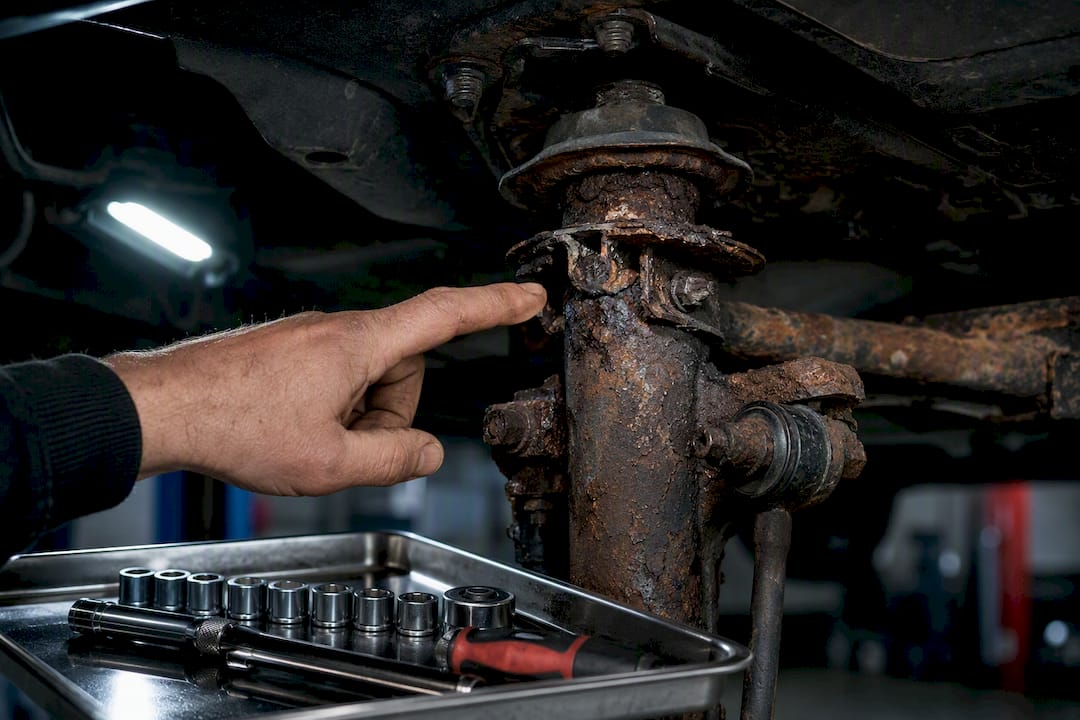
Corrosion is the silent cost multiplier. This is the one most people don't budget for. UK winters mean road salt, and salt means seized bolts, corroded top mounts, and fasteners that shear off rather than loosen. ClickMechanic notes that corrosion-related complications are one of the most common reasons a quoted job runs over both time and cost, particularly on cars from coastal or heavily gritted regions. Ask your mechanic to build in a contingency, or at least warn you before extra work starts.
Shocks vs struts changes the job entirely. A standalone shock absorber replacement is mechanically simple: unbolt, swap, rebolt. A MacPherson strut assembly is a structural part of the suspension geometry, and SuspensionHQ's technical breakdown explains why strut jobs cost more in both parts and labour, largely because they demand more careful reassembly and, in almost every case, a wheel alignment afterwards.
Electronic systems add diagnostic time. Adaptive damping and air suspension often need a scan tool to reset ride height sensors or recalibrate the control module once new parts go in. That's extra labour time that a basic shock swap simply doesn't need.
- Parts brand (economy vs OE vs premium)
- Labour rate (mobile mechanic, independent garage, main dealer)
- Corrosion and seized hardware
- Shock vs strut design
- Alignment or calibration requirements
What are the warning signs your shocks are failing, and will they fail your MOT?
Worn shock absorbers rarely announce themselves with a dramatic failure. They degrade slowly, which is exactly why so many drivers keep going until the MOT tester flags it.
- The bounce test. Push down hard on each corner of the car and release. A healthy shock stops the car settling within one bounce. If it keeps bobbing, the damping has gone.
- Nose-dive under braking. If the front of the car pitches forward sharply when you brake, worn front shocks are letting the springs move too freely.
- Body roll through corners. Excessive lean or a floaty, wallowing feel through bends is a classic symptom of tired damping.
- Uneven or cupped tyre wear. Shocks that can't control wheel movement properly cause the tyre to bounce against the road surface, creating a scalloped wear pattern.
- Visible oil leaks or damage. A shock leaking fluid down its body has failed internally and needs replacing, full stop.
MOT testers check for excessive corrosion, fluid leaks, and physical damage or looseness in the suspension mounting. A shock that's simply "getting old" but still functioning within tolerance won't automatically fail, but leaking fluid, a cracked mount, or excessive play at the mounting point will. Suspension-related failures are among the more common reasons cars fail their MOT, which is part of why it pays to catch wear before test day rather than after.
If your car exhibits nose-dive, heavy bounce, or visible leaks, it's worth having it checked before any long motorway journey. Compromised damping increases stopping distances and reduces control in an emergency swerve, which matters far more at 70mph than it does pulling out of your driveway.
What happens when a garage replaces your shock absorbers?
Understanding the actual job helps you judge whether a quote is fair, and whether you need a workshop or a mobile mechanic can handle it at your door.
- Inspection and confirmation. The mechanic checks both corners of the axle, confirms which parts are worn, and looks for corrosion or damage that might complicate removal.
- Removal. The wheel comes off, and the old shock or strut assembly is unbolted from the top mount and the lower control arm or axle.
- Fitting the new part. The replacement goes in, often with new top mounts and bushings if they show wear, and everything is torqued to the manufacturer's specification.
- Wheel alignment, if required. Standalone shock swaps usually don't disturb the car's geometry enough to need a full alignment. Strut replacements almost always do, because the strut forms part of the steering axis. SuspensionHQ confirms this is near-universal practice on strut jobs, adding roughly £40 to £80 and another hour to the visit.
- Test drive. A short road test checks for noise, correct damping feel, and no warning lights before the car is handed back.
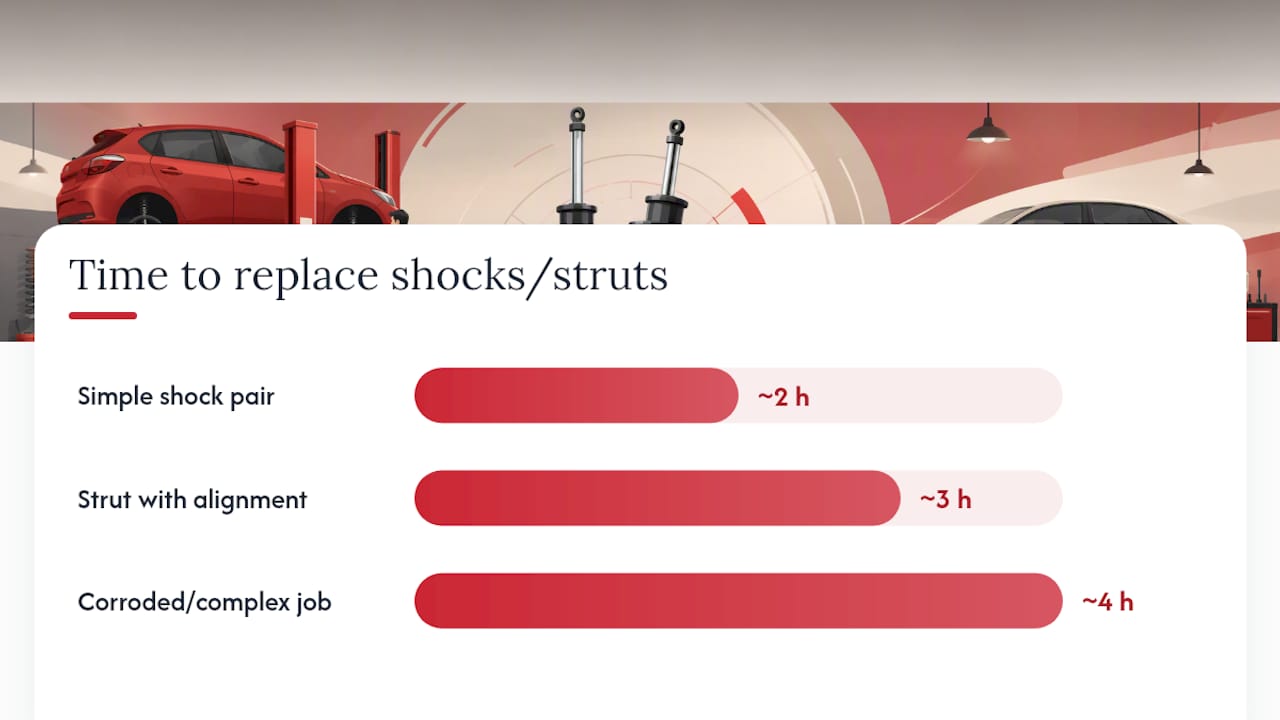
A straightforward axle-pair swap on a common hatchback typically takes a couple of hours. Add corroded bolts, hidden upper mounts buried behind trim, or a strut needing alignment, and that can stretch to half a day.
This is also where you decide between a mobile mechanic and a workshop. A simple shock pair with no alignment need is well suited to a driveway visit, since it needs nothing more than hand tools, a jack, and torque settings. Strut jobs requiring alignment, or any system needing electronic calibration, need a workshop with an alignment bay and diagnostic equipment. If a suspension repair follows a knock or minor collision, some vehicles also need airbag or crash-data module work handled by a specialist such as Airbag Reset UK before the car's back on the road properly.
How long do shock absorbers last, and how do you stretch that lifespan?
Most shock absorbers last tens of thousands of miles, though age matters as much as mileage. A shock that's done 40,000 miles over fifteen years has still been through fifteen winters of thermal cycling and corrosion exposure, and that takes its toll independently of distance covered.
Driving conditions shift that range considerably. Motorway-heavy driving on smooth roads is gentle on shocks. Frequent pothole impacts, unsurfaced roads, or a car regularly loaded with heavy cargo all accelerate wear, sometimes cutting the effective lifespan by a third or more.
Catching wear early is mostly about a few simple habits:
- Do the bounce test every few months, especially before a long trip
- Glance under the car occasionally for oil residue on the shock body
- Check tyre tread for cupping or scalloping, an early sign of damping failure
- Replace worn top mounts and bushings when you spot them, rather than waiting for them to fail the shocks alongside them
Pro Tip: If you replace shocks but leave badly worn mounts or bushings in place, you'll often need to redo part of the job within a year. Ask your mechanic to check these components at the same time, since they're a fraction of the labour cost when done together rather than as a separate visit.
Potholes are the single biggest avoidable cause of premature failure on UK roads. Slowing down for known bad stretches costs you nothing and adds real years to a shock's working life.
How do you get an accurate quote for shock absorber replacement?
The biggest single mistake drivers make when comparing quotes is comparing numbers without comparing what's actually included. A £180 quote and a £320 quote for the "same job" often aren't the same job at all.
Ask every garage or mobile mechanic for an itemised breakdown covering:
- Exact part brand and part number, not just "shock absorber"
- Labour charged as hours worked or as a fixed fee
- Whether VAT is included in the headline price
- Warranty terms on both parts and labour separately
- Whether wheel alignment is included or billed as an extra
- Any disposal fee for the old parts
| What to check | Why it matters |
|---|---|
| Part brand/number | Confirms whether you're getting economy, OE-equivalent, or premium parts |
| Labour basis | Fixed fee vs hourly rate changes what happens if the job overruns |
| VAT inclusion | A quote missing VAT can look significantly cheaper than it actually is |
| Warranty | Parts and labour warranties often differ in length and cover |
| Alignment | Struts usually need it; shocks usually don't; confirm which applies |
| Disposal fee | Small but sometimes tacked on as a surprise at collection |
Red flags worth watching for: a quote that names no specific part, a labour line with no hours or fixed fee attached, or a price that sits well below every other quote you've received with no explanation. That last one usually means either budget parts, a shortcut on alignment, or a surprise add-on waiting once the wheel comes off.
For a simple axle-pair job with no alignment requirement, a mobile mechanic is often the most cost-effective and convenient route, since you avoid workshop overheads and travel time entirely. Struts, adaptive systems, or anything needing an alignment bay generally point you towards an independent garage or dealer with the right equipment.
When does a mobile mechanic make sense for a shocks job?
Most shock absorber replacements handled at a customer's home or workplace are straightforward axle-pair swaps, no alignment involved, and that's exactly the job type suited to a driveway visit rather than a workshop booking.
If your car needs a strut replacement, has adaptive damping, or is on air suspension, that's a workshop job. Alignment bays and calibration tools aren't things you carry in a van, and pretending otherwise would just cost you a second visit later.
Before quoting, every inspection covers both corners of the axle, checks for corrosion around the mounts, and looks at bushings and top mounts, not just the shock itself. The quote that follows lists the part, the labour, and anything else found, before any work starts. No vague lines, no surprise extras added at collection.
— David
Book a mobile mechanic for your shock absorber replacement
If your car needs a straightforward axle-pair shock swap, you don't need to book a day off work and sit in a waiting room. Mobile mechanics can come to your home or workplace with a free call-out within the coverage area and no charge for turning up.

Every quote is itemised before work begins: the part, the labour, and nothing added on afterwards. There's no upselling and no vague pricing, just the job you asked for at the price you were told. A typical axle-pair replacement is usually completed on-site within a couple of hours, so you can be back on the road the same day without a garage detour. If your suspension turns out to need a full workshop job, such as a strut replacement needing alignment, you'll be told plainly rather than talked into unnecessary extras.
Cars in Knutsford, Wilmslow, Crewe, Alderley Edge, Sandbach, Nantwich and Whitchurch are all within reach. Head to Trackside Auto's mobile mechanic booking page to check availability and get a straight, itemised quote for your car.
Where these figures come from
The price ranges and technical points in this guide are drawn from a handful of UK-focused sources built specifically around real garage pricing and suspension mechanics.
- ClickMechanic's job pricing page for garage-quote ranges and cost drivers
- Autodoc's UK cost guide for axle-specific pricing examples
- SuspensionHQ's technical breakdown for the shock-versus-strut distinction and alignment requirements
- CurrentCost's example job scenarios for parts-and-labour breakdowns used to build budgeting examples
Sources
- Shock Absorber replacement & repair
- Shock absorber replacement cost and when to replace it
- Shock Absorber Replacement Cost Guide – Current Cost